


At Invite, we exist to build a like-hearted community of influencers who are high on Jesus, low on politics, biased toward innovation, and serious about discipleship.
But what does it mean to be “Serious About Discipleship”?
Have you ever asked a room of lifelong churchgoers to define the word disciple? Invite author Roger Ross did and then wrote a book, Kinda Christian, after watching a church struggle for seven months to define the word.
Many of us in church are full of information about Jesus. We can name the books of the Bible and how to volunteer at the food bank.
But the word disciple?
No idea.
In spite of the fact that this is supposed to be the raison d’être!
We have information but lack formation.
The problem goes back to our definition of knowledge, which is cognitive and conceptual not embodied or relational. I address this in an article on my Substack, More Like Jesus. We are full of dialogismos, like the Pharisees, but lack epignosis, like Jesus.
The word “disciple” comes from the Greek mathetes, which means a learner or apprentice. To understand it, you need to know the style of education in the day, which was rooted in imitation. A student moves into a workshop and picks up the trade by standing at the master’s elbow, day after day, until his own hands begin to move the way the master’s hands move.
Jesus said as much: “The student is not above the teacher, but everyone who is fully trained will be like their teacher.” (Luke 6:40)
A disciple often begins with imitation (Paul says, “imitate me as I imitate Christ”), then moves from imitation to “withness” (a deeper level of intimacy than imitation, which centers on quality time spent together), then from withness to indwelling.
This by the way is the layered meaning of More Like Jesus. The “like” is narrative in nature. It is not a static declaration but a reference to a journey. It captures the spoken desire of people curious about following Jesus, moves to abiding in God’s presence, and ultimately to union with God.
Notice what Jesus commanded when he handed his followers their commission. He did not say, go and make converts. He did not say make believers, or attenders, or donors. He said,
“Go and make disciples of all nations.” (Matt 28:19)
The verb is singular and stubborn. Every other thing a church does—the building, the budget, the lights, the coffee in the lobby—exists to serve that one command, or it is useless or even worse a poor use of valuable resources.
The problem is that the modern church has grown very good at information and very shy about formation. We will teach you what the Council of Nicaea settled in 325 and never once ask whether you have forgiven your brother.
We grade discipleship the way a school grades a pupil, by what he can recall on the test, when Jesus graded it by whether the branch bore fruit. A person can know everything about Jesus and not host him or even resemble him whatsoever.
The demons, James notes dryly, have airtight theology. They believe, and they shudder. (James 2:19)
So let’s dismiss with this nonsense that information about Jesus constitutes following Jesus.
To be serious about discipleship is to keep our eyes on the goal Jesus set—likeness to himself—and to refuse the cheaper substitutes that keep offering themselves in its place. Paul called it a slow work of the Spirit: “we all… are being transformed into his image with ever-increasing glory.” (2 Cor 3:18) Elsewhere he sounds less like a theologian than a mother in hard labor: “my dear children, for whom I am again in the pains of childbirth until Christ is formed in you.” (Gal 4:19) Formed.
The fathers had a word for the destination. They called it union with God.
Christ in you.
And why serious? Because for a generation we made discipleship sound easy, when it is not.
We took the lifelong journey of following Jesus and shrank it to a single transaction at the front of a sanctuary—a raised hand, a repeated prayer, a signed card—then stood back, puzzled, as the pews filled with people who had decided and then did nothing about it.
Theologian and Nazi-resister Dietrich Bonhoeffer had a name for this. He called it cheap grace: grace without discipleship, grace without the cross, grace as a doctrine you affirm instead of a life you lose.
The cost has always been clear. Jesus put it in three-inch type above the fold. Take up your cross. Count the cost. The gate is narrow and few find it, not because God is stingy, but because the road asks for everything you carry.
Discipleship is why Invite exists, and why we make what we make. A trade book can inform you, and a good one will. But formation happens in the doing—in the practice, in the reflection, in the return week after week to the same table with the same stubborn people and the same patient Lord. It is why our workbooks put a pen in your hand and ask you to write. It is why we pay less attention to how many books leave the warehouse than to whether one reader, a year from now, looks a little more like Jesus than she does today.
So we return to the churchgoers who could not quite say what a disciple is. The answer was never a definition to memorize for the quiz. It was an invitation to move into the workshop, to bind our hours to the Master’s, and to stand at his elbow long enough that on some ordinary morning, we catch our own hands moving like his. To be serious about discipleship is to want it more than we want to be comfortable, or right, or safe.
It is to want, above everything else a life can want, to become like Jesus.
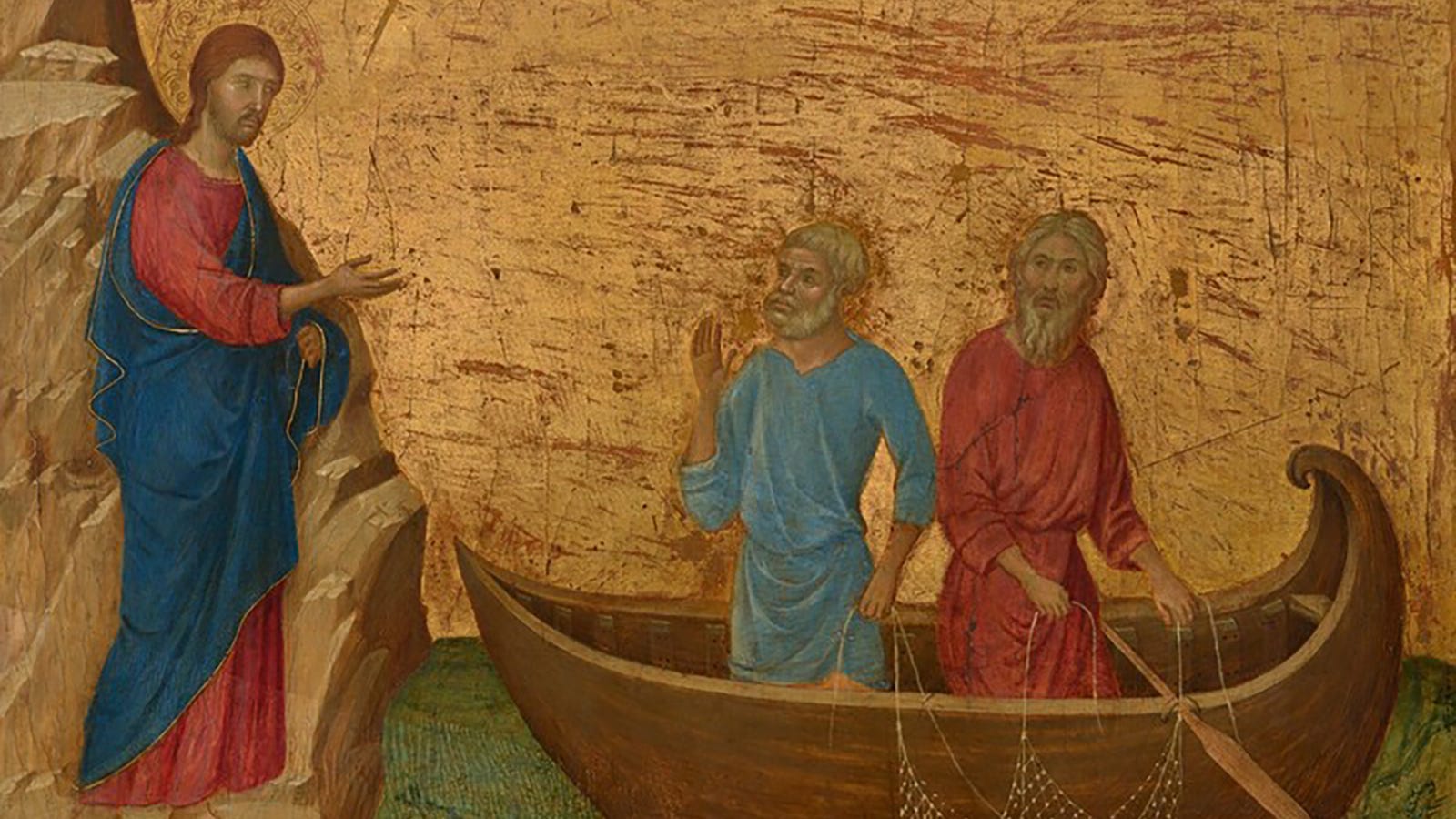
Image: Duccio, “The Calling of the Apostles Peter and Andrew” (1308–11), public domain.