The Problem of Good
N.T. Wright turns the oldest objection to faith inside out, and hands your small group a better question.
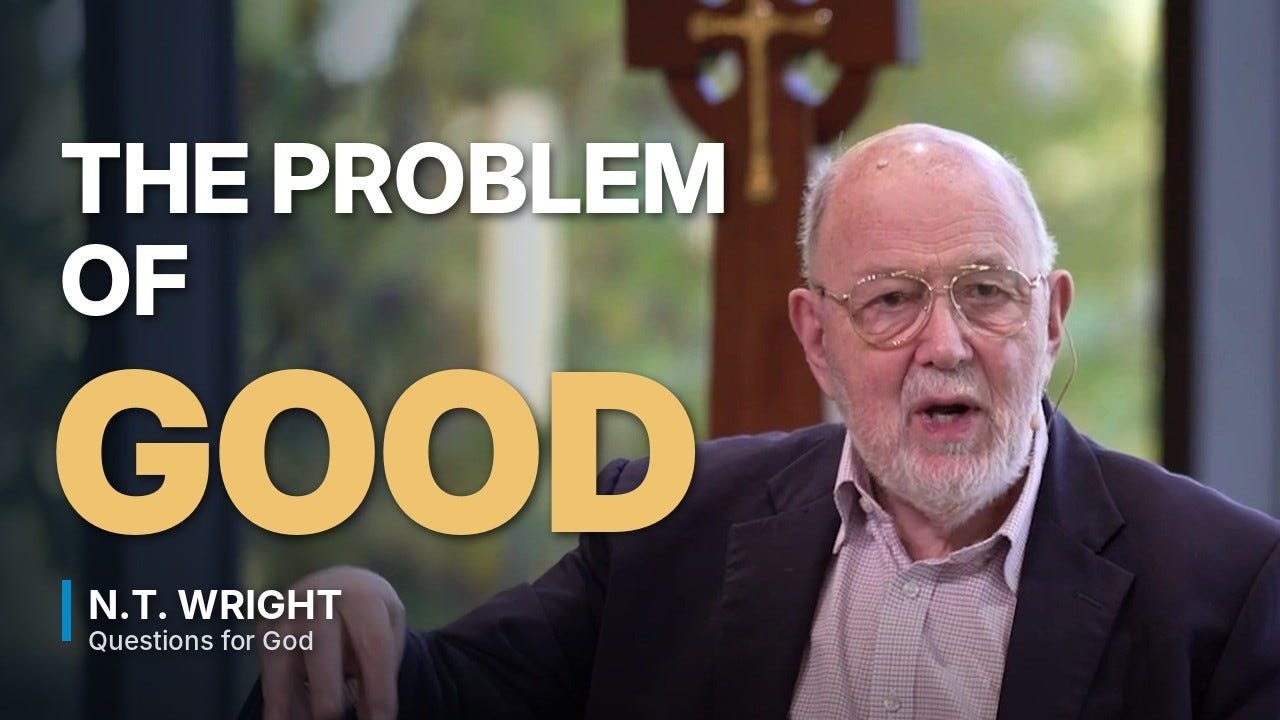
Arthur Jones didn’t want the milquetoast seminar version of the evil question.
As he sat with renowned theologian N.T. Wright to film Questions for God, he pushed on the real, coffee-shop version, the one a college student asks: how do you describe goodness to students who have spent most of their lives staring at a screen whose algorithms define what good is, and it isn’t very good?
As Wright often does, he didn’t accept the question on its own terms, but rewrote it in his reply.
Theologians have long talked about the problem of evil, he said, but if you don’t believe in a Creator, the problem runs the other way. In a world this dark and violent, why is there still joy? Why laughter, beauty, springtime?
It took him less than two minutes to blow everyone’s minds:
From the book
This excerpt comes from Questions for God by Arthur D. Jones with N.T. Wright (Invite Press, 2026).
But Wright goes further. When pressed on whether young people actually believe the world is good, he reverses the familiar objection. The real puzzle, he argues, is not the problem of evil but the problem of good. If the world is dark, messy, and violent, why is there still joy? Why beauty? Why laughter and springtime? The very fact that we recognize ugliness means we already sense that something is supposed to be different. We could not call the world broken if we did not carry some memory—or some longing—for wholeness.
This reversal often lands harder than expected. Students raised on algorithms that amplify outrage and despair are not accustomed to being asked why good things exist at all. The question interrupts the assumed narrative. It suggests that goodness is not an illusion but a signal—a fingerprint of the Creator on a world that remains, despite everything, his.
The reversal doesn’t make suffering smaller. The same book refuses to hurry past grief, and it says so a few chapters later:
In this framework, the answer to evil is not primarily a theory—it is an event. The crucifixion reveals a God who does not remain safely above the world’s pain. The resurrection reveals that suffering, death, and injustice are not ultimate realities. They are enemies to be defeated, not puzzles to be solved.
Why this matters for your group
Most of us have been handed the problem of evil as an accusation.
As he points out, our outrage at the world’s ugliness is itself a clue. You can only call a line crooked if you already know what straight looks like.
For a pastor or group leader, that changes how the conversation starts. You don’t open with a defense. You open with wonder, and then you let the hard questions in.
Three questions from the Questions for God group guide to try this week:
Wright flips the problem of evil into the problem of good—if the world is so dark, why is there still joy, beauty, and laughter? Where have you encountered unexpected goodness that didn’t fit your expectations?
Wright says evil is “parasitic upon goodness”—it can only distort or destroy what is already good. Does that framework help you think about suffering differently?
Is there someone in your life right now who is suffering? What might it look like to simply sit with them rather than trying to explain?
Take it to your church
Questions for God is a ten-session study for groups: the book, a write-in workbook, and video sessions with Arthur D. Jones and N.T. Wright. Every order includes a free Preaching & Teaching Guide for pastors who want to run it church-wide.
Get the book, workbook & video study →
Want the full transcript of the conversation? Read it here.
This post has an arresting effect on me. Never ever thought about the problem of Good.